

The year 2020 taught me a hard lesson about executive burnout, a reality I now see in so many driven leaders. I used to believe, like many of my clients, that the path to the top was paved with endless hours and relentless self-sacrifice. “I will sleep when I am DEAD! Sleep is for lazy people! There is work to be done!” one CEO once told me, echoing a common sentiment. Another shared, “I cannot get anyone to deliver tasks impeccably! I’ll just do it myself, even if it means no self-care.”
This “always-on” mentality, while often lauded, is actually the silent saboteur of your peak performance. It’s the executive paradox: the very ambition that drives your success can, unchecked, lead to an unsustainable spiral of exhaustion and diminishing returns.
Burnout isn’t a sign of weakness; it’s a systemic issue, and it comes with devastating costs. The good news? You can break free from this grind and achieve sustainable peak performance.
Executive Burnout Costs: When Your Leadership Engine Stalls
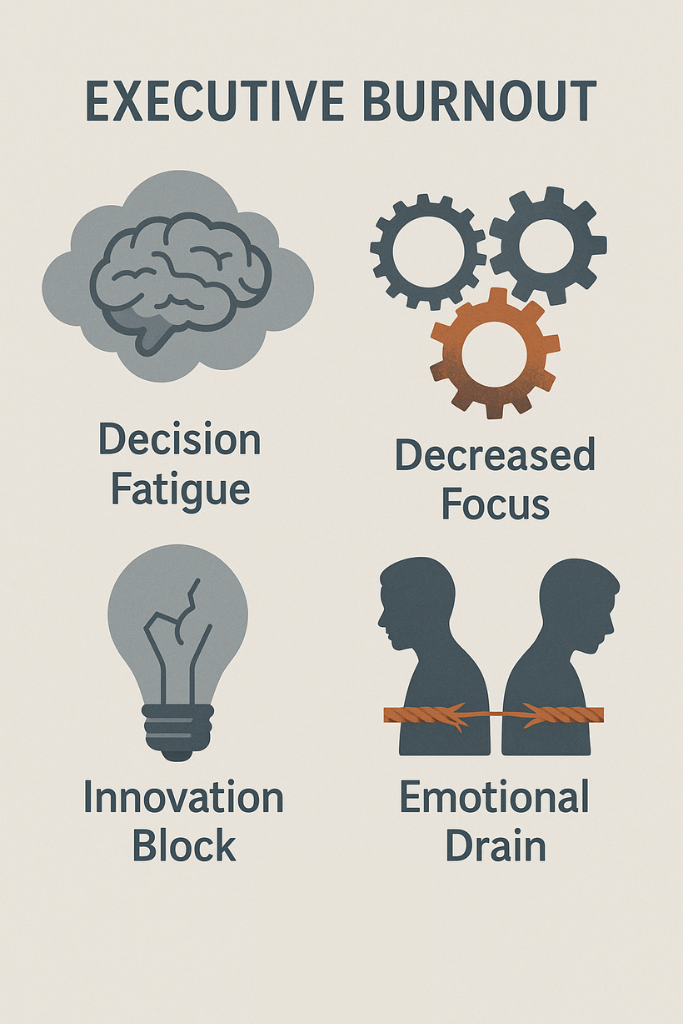
For leaders, the impact of burnout extends far beyond feeling tired. It’s a strategic liability that affects your entire organization, secretly robbing you of your most valuable assets and stealing your edge.
Here’s what executive burnout truly costs you:
Clouded Judgment & Bad Decisions
Ever feel like your brain’s in a fog? When you are running on fumes, even simple decisions feel heavy, leading to costly mistakes. That sharp intuition? Gone. Research shows that just one night of poor sleep can severely impair your executive functions, like making clear decisions and thinking on your feet.
Crushed Innovation & Creativity
Those “aha!” moments, the big ideas that drive your business forward? They vanish when you’re burnt out. Your tired brain can’t process new information effectively, making creative breakthroughs feel impossible. (Samantha Shakira Clarke: How Sleep Impacts Leadership Performance)
Endless Hours, Zero Impact
This is where it hits hard: that frustrating feeling of spending three hours on a task that should take 30 minutes because your mind is scattered, irritable, and forgetful. You’re “on the edge,” but not in a good way – just constantly agitated, inefficient, and far from optimal. This inefficiency is a direct result of leadership burnout.
Strained Relationships
Ever snap at a colleague or feel distant from your family? Exhaustion often leads to being short-tempered and emotionally distant, eroding trust and connections at work and at home.
Real Health Issues
Burnout isn’t just a feeling; it physically breaks you down. Chronic stress can lead to serious health problems like high blood pressure, anxiety, and constant sickness, impacting your longevity and quality of life. My own experience with burnout in 2020 resulted in an enlarged heart, a medical condition closely linked to high blood pressure, and a significant risk given my family history
A Culture of Overload
As a leader, you set the pace. A burned-out executive unintentionally creates a high-stress, overwork culture where everyone feels they have to do it all, perpetuating the cycle across your team.
The Nigerian Reality: Why We Often Wait Until It Breaks (And Why That’s Costly)

In Nigeria, these executive pressures often come with unique cultural layers. Our strong work ethic can sometimes morph into a deep reluctance to delegate, fueled by the belief that “if you want it done right, do it yourself.” Traditional hierarchies, too, can sometimes make it harder for junior staff to step up or for leaders to truly offload their burdens. This contributes significantly to Nigerian executive burnout.
What I’ve observed is many executives adopt a “reactive” mental approach: “If it is not broken, don’t fix it.” Well-being is often addressed only when a crisis hits, when a breakdown forces a pause. While resilience is a valuable trait, relying solely on reactive measures in the face of intense professional demands is not a sustainable, holistic strategy for the long haul to prevent leadership burnout.
Your Playbook for Preventing Executive Burnout: Lasting Energy & Peak Performance
Achieving sustainable peak performance isn’t about working less; it’s about working smarter, living more intentionally, and truly understanding the difference between urgent and important. It’s about being effective, not just busy.
1. Rest Is Your Secret Weapon

The Science of Sleep: Forget the idea of “sleeping when you’re dead.” Quality sleep is non-negotiable for sharp thinking and your ability to bounce back from challenges. Aim for the recommended 7-9 hours of sleep each night. Research clearly shows that not getting enough sleep impairs memory, judgment, and reaction time. (Frontiers in Neuroscience: The impact of sleep deprivation on Cognitive Function) Prioritize consistent sleep habits. Create a calming wind-down routine and protect your sleep hours like you protect your most important meetings.
Actionable Step: Try setting a “digital sunset” alarm on your phone for 60 minutes before you plan to go to bed. Use this hour for non-screen activities like reading, stretching, or listening to calming music.
Micro-Breaks & Active Recovery: Sprinkle short, intentional breaks throughout your day. This will cause a mental and physical reset. Studies (Illinois News Bureau: Brief diversions vastly improve focus, researchers find) have shown that even brief diversions from a task can dramatically improve focus and performance on prolonged tasks. A quick walk, 5-minute stretch breaks (*yes, like we discussed in our post, “The Underrated Impact of Stretch Breaks”), or moments of mindfulness can significantly boost your alertness and reduce fatigue, directly combating executive burnout.
Actionable Step: Set a timer for every 60-90 minutes of focused work. When it rings, stand up, stretch, and walk away from your desk for just 2-5 minutes. Even a short trip to get water can reset your focus.
2. Trying to Do Everything Yourself Is Holding You Back (And How to Empower Your Team)

Boundary Setting: Learn to protect your non-work time. Strategically saying “no” to non-essential demands is just as important as saying “yes” to the right opportunities. This creates the space for genuine recovery from leadership burnout. As Forbes highlights, “Set boundaries and stick to them” is a crucial step in preventing burnout.
Deep Work Blocks: Schedule dedicated, uninterrupted time for high-level, strategic tasks that demand your full focus. Minimize distractions during these critical periods.
Actionable Step: Block out 90 minutes on your calendar for “deep work” each day this week. Turn off email/chat notifications during this time and communicate to your team that you’re in a focus block.
Overcoming Perfectionism & Delegating to Build Competence: That belief of “I cannot get anyone to deliver tasks impeccably”? It’s a classic burnout trap rooted in perfectionism, a personality trait closely linked to stress and burnout. (SciSpace: The effect of perfectionism on burnout) This is your chance to overcome perfectionism by slightly lowering initial expectations and empowering your team. Delegation for leaders isn’t just about offloading; it’s about building competence over time. Trusting your team, providing clear guidance, and allowing for learning curves frees up your invaluable time for truly executive-level work. Effective delegation significantly reduces a leader’s workload and promotes a better work-life balance. (The Grossman Group: 6 Benefits of Delegation)
Mindset Shift: Stop seeing delegation as ‘offloading’ or risking imperfection. Instead, view it as an investment in leveraging your time and developing your team’s capacity. You’re not losing control; you’re gaining strategic bandwidth to combat executive burnout.
Actionable Step: This week, choose one ‘light-weight’ task you usually do perfectly (but isn’t the best use of your strategic time). Instead of just assigning it, take 15-20 minutes to coach a junior colleague through it. Lower your initial expectations for their perfect execution, focusing instead on their learning and growth. See this as an opportunity to develop them to eventually handle tasks you currently do, freeing up your time for more strategic and developmental work. The burden of doing it all yourself is exchanged for the immense gain of a more skilled team and a lighter workload for you in the long run, contributing to your sustainable peak performance.
3. Beyond Work: Why Real Connections & Fun Are Your Ultimate Recharge

Social Connection & Fun: Actively cultivate robust social connections and engage in activities purely for fun – things that light you up outside of work. Research consistently shows that strong social connections can significantly reduce stress levels, enhance mental well-being, and even boost the immune system. (HelpGuide.org: Social Support for Stress Relief) As the “juggling balls” metaphor illustrates, imagine your life as a series of balls you’re juggling. Some are made of glass (family, health, integrity) and will shatter if dropped. Others are rubber (work deadlines, minor tasks) and will bounce back. Too often, executives prioritize the rubber balls, letting the glass ones break. Re-engaging with hobbies, friends, and family before a crisis hits is paramount for preventing executive burnout.
Actionable Step: Schedule one non-work related activity this week. This could be a quick coffee with a friend, spending 30 minutes on a hobby you enjoy, or a short walk in nature with no distractions.
Digital Detox: Schedule periods away from your screens – an hour before bed, a full day on weekends. This allows your mind to truly disengage and recover, preventing digital fatigue and giving your brain the space to breathe, helping to avoid leadership burnout.
Actionable Step: Put your phone away during family meals or social gatherings. Try leaving it in another room to be fully present in the moment.
Executive Well-being: Leading from a Full Tank & Inspiring Your Team
This isn’t theory. I know this reality intimately because I experienced severe burnout in 2020. Like many high-achieving executives, I once operated under the belief that I had to carry every burden and that ‘sleep was for the dead’. The journey through that period profoundly reshaped my perspective, revealing that true leadership isn’t about how hard you can push yourself to the brink, but how strategically you can sustain your energy and performance.
When executives prioritize their own health and well-being, it sends a powerful message throughout the organization. You become a role model for sustainable success, inspiring your team to adopt healthier practices and preventing widespread burnout across your workforce. This is why “well-being is the next business imperative,” as noted by Seramount.
Your story doesn’t have to be one of breakdown, but of breakthrough. You have the power to protect your most valuable asset – yourself – and by doing so, truly elevate your leadership. Ready to shift from surviving to thriving? Explore resources that support executive well-being, commit to one self-care practice this month, and lead the charge for a healthier, more sustainable future for yourself and your organization
Ready to Lead with Lasting Energy? Your Next Steps to Sustainable Peak Performance
The path to sustainable peak performance means moving beyond the reactive “if it’s not broken” mentality to a proactive commitment to your well-being. It’s about recognizing that being “always on” eventually leads to a breakdown, and that true strength lies in strategic recovery and empowered delegation. As IMD emphasizes, “Executive recovery is the backbone of thriving organizations.”
Are you ready to shift from just surviving to truly thriving in your leadership role? To move past the belief that sleep is for the dead and embrace a life where you are vibrantly alive, making sharp decisions, and empowering your team?
Explore how tailored executive well-being coaching can help you achieve sustainable peak performance.
Save this post, share it with a colleague who needs to hear this, and repost it on your LinkedIn. Follow me for more insights into achieving peak performance through sustainable well-being.
Let’s redefine what it means to be a truly successful leader.
Frequently Asked Questions About Executive Burnout
Q: What is executive burnout?
A: Executive burnout is a state of physical, mental, and emotional exhaustion caused by prolonged or excessive stress, particularly in demanding leadership roles. It’s characterized by feelings of overwhelm, cynicism, and reduced effectiveness.
Q: What are the main costs of executive burnout?
A: Burnout in leaders can lead to clouded judgment, decreased innovation, reduced productivity despite long hours, strained relationships, serious physical health issues, and can even perpetuate a culture of overload within the organization.
Q: How can I achieve sustainable peak performance without burning out?
A: Sustainable peak performance involves strategic practices like prioritizing quality sleep and micro-breaks, setting clear boundaries, delegating effectively to empower your team, and actively cultivating social connections and hobbies outside of work.
Q: Is burnout a sign of weakness?
A: Absolutely not. Burnout is a systemic issue, often a result of unsustainable demands and environments, rather than a personal failing. Recognizing and addressing it is a sign of strength and effective leadership.
Q: How can executive coaching help with burnout?
A: Tailored executive coaching provides personalized strategies and accountability to help leaders identify the root causes of their burnout, develop sustainable habits, improve delegation skills, and build resilience to maintain peak performance without sacrificing well-being.